R. Garcia's Website
  • Home
  • Documents
    • Fiction
    • Poetry and Poetry-Related
    • Humor
    • Essays
    • Photographs
  • Blog: The Eclectic Life
  • Quotes
  • Books
    • The Sun Zebra
  • : ^ )
    • Fun Quotes
    • Rolando's Official Web Mascot
    • Cool Videos
    • The Power of Words
    • Odd and Fantastic Pictures
  • Contact

The Mystery of the 3 Star Reviews

6/8/2012

16 Comments

 
I was looking at the patterns of 5, 4, 3, 2, and 1 star reviews of books on Amazon and I noticed something interesting that I want to share with you.

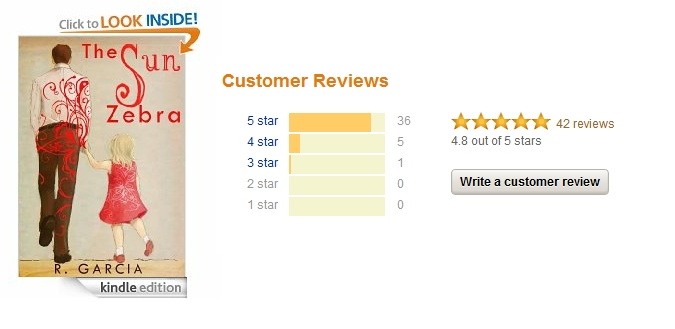
When you look at a book’s Amazon page there is a graph that displays the number of total reviews a book has, distributed by the number of stars. Taking my own book, the Sun Zebra, as an example, the graph looks like this:
Picture
This is an example of the type of graph you get when readers like a book. There are many 5 star reviews and a much lower number of reviews with fewer stars. However, even 42 is not a lot of reviews for statistical purposes, so I will concentrate here on books that have 200 or more reviews.

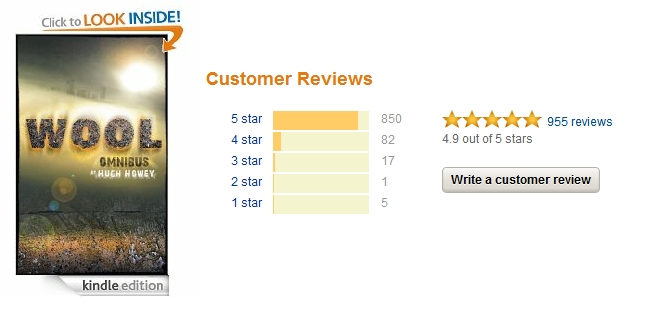
The first such book I want to show you is “Wool” by Hugh Howey. Having a book with this many reviews and almost a 4.9 average is a significant accomplishment for an author and a sure sign the vast majority of readers loved the book. A large bar of 5 star reviews is characteristic of very popular books.
Picture
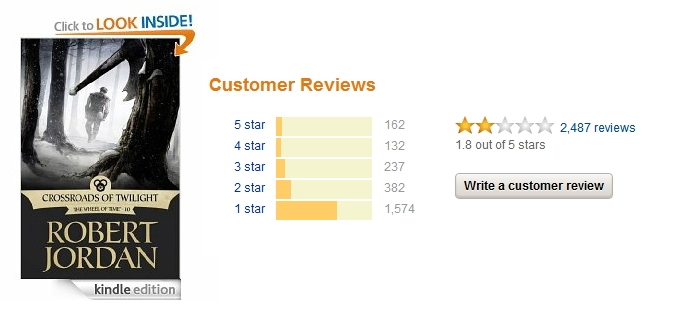
The converse is also true. For example, Robert Jordan’s “Crossroads of Twilight” is an example of a book a lot of readers bought but the majority didn’t like. Here you find a situation where you have a large bar with 1 star reviews.
Picture
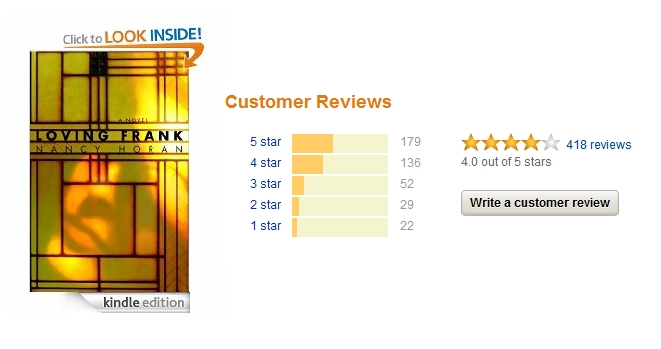
I also wanted to see how these graphs looked in books with intermediate ratings. For example, could I find books with large bars of 4 and 2 star reviews? After skimming over 4,000 books on Amazon that I searched by “popularity” and “reviews of 1 star or more,” to my surprise I found none. The most common way in which a book gets an average rating of 4 is because the number of 4, 3, 2, and 1 star reviews counteract the effect of the 5 star reviews such as in the case of “Loving Frank” by Nancy Hogan.
Picture
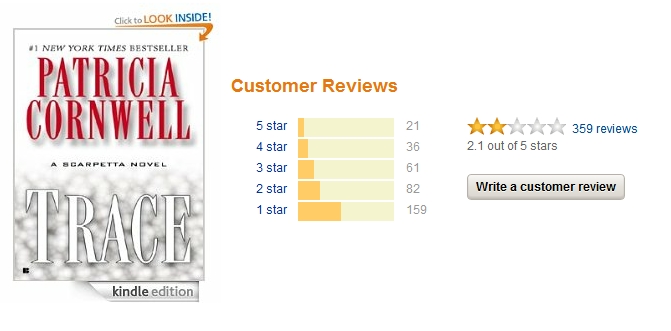
Likewise, I could not find any book with a rating of near 2 with a prominent bar of 2 star reviews. The way a book ends up with an average rating of 2 is that the number of 5, 4, 3, and 2 star reviews bring up the average counteracting the effect of the 1 star reviews such as the book “Trace” by Patricia Cornwell.
Picture
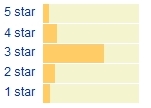
I was especially interested in 3 star reviews because these indicate that, in theory, the book is neither very good nor very bad. Surely I would find a book with 200 or more reviews and a prominent 3 star column, like this example that I made up:
Picture
That was not the case.

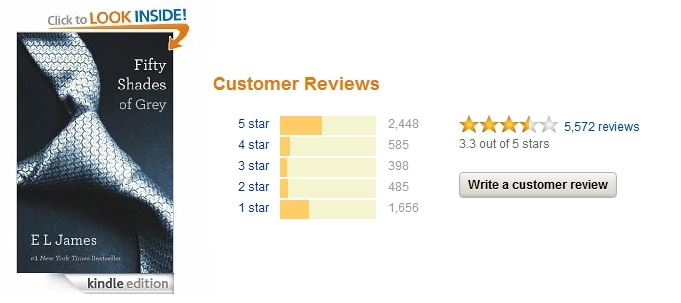
The way a book ends up with a rating of around 3 on Amazon is if a lot of people like it but an equally large number of people hate it. Such is the situation of “Fifty Shades of Grey” by E. L. James. Here there are 2 large bars at opposite ends of the scale: 5 stars and 1 stars.
Picture
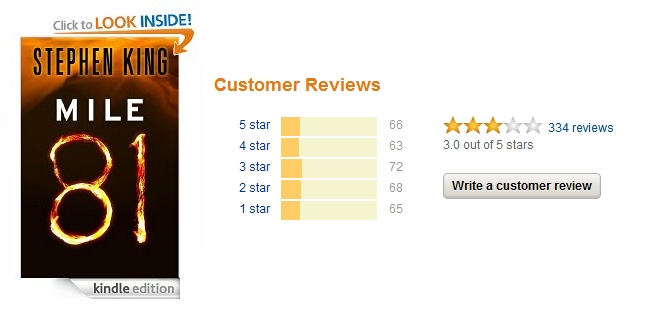
However, the situation doesn’t have to be this extreme. Take the book “Mile 81” by Stephen King. Here the 5, 4, 3, 2, and 1 star reviews are nearly all the same, and the graph is a near flat line.
Picture
I want to state that the reason I didn’t find it is that I may have missed it (I only checked 4,000 books and there are more than one million books on Amazon).  So please if you know of any book with 200 or more reviews and a prominent 3 star bar that stretches past all the others, please leave a comment and let me know.

But let’s get to the point of this post. If my observations are true, what does this say about the psychology of the reviewer? Why does an average book achieve a neutral rating of “3,” not by the majority of the reviewers giving it a 3, but rather by half of the reviewers rating it above 3 and the other half rating it below 3? Is this a reflection of our polarized society where we can’t find a middle ground on anything?

What do you think?

Note: the links on the books are provided just so you can check them out. I do not advocate you buying them except, of course, my own.  : ^ )


                                    ***
If you like this blog you can have links to each week's posts delivered to your e-mail address. Please click here.
16 Comments

My Free Promotion Experience and Some Questions About "Free"

5/4/2012

7 Comments

 
I published my book The Sun Zebra in November of 2011. From that date to the time I did my first successful free promotion on April 11 (about 20 weeks) I promoted, e-mailed, tweeted, blogged, and whatnot but only managed to sell 27 copies of my book. That is 1.35 copies per week. This is an experience that many first authors go through. In fact, the rule of thumb used to be that self-published authors would sell on the average only 100 copies of their books. The best ranking my book ever achieved was 17,580 and from there it started sinking reaching a ranking of 500,000 on a couple of occasions. Every now and then a buy would send it “soaring” close to 100,000 after which it would start sinking again. Then along came Amazon’s KDP Select program, which allows authors to give away their book for free.

Here let me state that I did an early promotion that did not go well but then I introduced some changes to my book and marketing strategy, and I tried the promotion again. I gave my book away for free during 3 days. People downloaded 19,000 plus copies sending it as high as #9 in the free Kindle store. When the promotion ended it ranked #1,999 and in the 3 weeks since the promotion I have sold 170 copies with 46 units being borrowed, which (at a book price of $1.99) may count for 80 units or more. Even though I expected better results because my book and its cover are really good, it is a collection of short stories, and short stories are not a very popular category. This is why I think it did not gain further traction in the Kindle store. Other authors have had better experiences.

However, with the promotion I achieved in 3 weeks results that I had not achieved in the 4 plus previous months. Although even with these improved sales figures I will obviously not be quitting my day job anytime soon, the point is that with the KDP Select program Amazon has given no name self-published writers like me a powerful promotional tool; if we use it well.

My question is: for how long?

There are 140,000 books in the KDP Select program and more are being added all the time. Multiplying that by 5 gives you the number of free days these books represent. There is now an endless supply of free books on Amazon. Unless a reader cares about reading a series or about an author’s other works, it is possible for said reader to upload hundreds of books into his/her Kindle without spending a single cent. So far “free” seems to still work. People are downloading free books but they are still buying. In fact the sales of some well-known authors have actually been increased by the program. But can we expect this to go on forever?

                                   ***
If you like this blog you can have links to each week's posts delivered to your e-mail address. Please click here.
7 Comments

Has the KDP Select program worked for self-published authors?

2/11/2012

2 Comments

 
As many of you know, Amazon has a program called the KDP Select which allows books to be checked out as a loan by readers participating in the program. Amazon has created a fund of money that is distributed among the total number of loans. Therefore, authors get paid every time a reader checks out their book. Additionally the program gives authors the ability to offer their books for free for 5 days. The catch is exclusivity. If you enroll your book to participate in the program it cannot be sold in any other outlet but Amazon. So, how has this program fared?

Amazon claims that so far the program has been a success. In December of last year 295,000 books were borrowed paying each author $1.70 per borrow and the KDP Select lending library has swelled to 75,000 books. As a result of this, authors and publishers participating in the program increased their income by 26%. The company now has increased this fund from $500,000 in December to $700,000 in January.

In addition to the money earned from books being lent, Amazon also noted that sales of KDP Select tittles also increased compared to those that were not in the program. An evaluation of Kindle owners participating the in the program compared to those that did not revealed that the ones participating bought 30% more books than the ones that didn't.

The combined effect of royalties coming from borrowed books and from sales of more books has resulted in the top ten KDP select authors growing their book income 449% from November to December.

By permitting authors to give away their book for free for a few days, Amazon has given them a powerful promotional tool that allows new readers to discover them. Overall the KDP Select program has had the effect of allowing self-published authors access to the top 10 slots of the different genres, displacing books by more traditional publishers.

So it's that easy eh? Enroll your book in the KDP Select program, give it away for free for a few days and sit back and watch your sales increase.

Not so fast.

Giving your book away for free only seems to drive its sales after the free period if your book makes it to the top 100 in the charts of its respective category. Therefore making your book free is not enough. You have to promote your book to make sure it gets enough downloads to reach that magic 100 bracket. Thus authors have to alert their e-mail contacts and work their social media to let readers know their book is free on a particular day. In fact, some authors have placed paid advertisements in major book blogs. Yes, you read that right. Pay money to let readers know that you are giving your book away for free!

The program seems to work best for authors with several published books because free promotion of one of the books will drive sales of the others. This is especially true if the book being promoted is part of a series. Also, having more books in the program gives you more free promotional days. Finally, the genre in which the book is in also seems to matter. If your book is in the more popular genres, it will tend to get more downloads when promoted.

So the answer is yes, the KDP Select program seems to have worked for self-published authors as a whole but in general it favors those who have been around longer, have more books, and/or are able to marshal the promotional forces that can make their books reach the top ranks. For the no-name author who has put out his/her first book it is an additional promotional tool but the climb to the top is still steep.

There are two final considerations to be made. One is that, as the KDP Select program becomes more popular, the market will be swamped with free books and its effectiveness may decrease. The other consideration is that the avalanche of free books may provide a windfall for book plagiarists who can now obtain many books for free and quickly republish them with new covers and author names. This is a big problem at Amazon and it's getting worse every day.


2 Comments

Is Amazon Getting too Big?

1/7/2012

2 Comments

 
Let me first come out and say publicly that I publish on Amazon. However, I have a concern: Amazon is getting pretty big.

Just how big is Amazon? According to Frugal Dad Amazon's annual revenues are 34 billion; an amount that is bigger than the GDP of half of the countries in the world. Its web sales are 5X the web sales of WalMart, Target, and Buy.com combined. It serves 137 million customers per week. Its warehouses occupy the space that would be covered by 700 Madison Square Gardens. If Amazon were a country for active users it would be 2X the size of Canada. 

You get the gist don't you? Amazon is a giant well on its way to becoming an economic empire. So far it has been able to leave behind every company that has competed with it, and it shows no sign of abating. Amazon is going for the jugular in many areas to leave its competition behind or destroy it completely. For example, Amazon was encouraging costumers to use a price check app when they went into brick and mortar stores to scan products sold there. If they found they could get a better price online they would get a 5% credit on Amazon. The company in effect was using customers for espionage. Another example is the Kindle Direct Publishing Select program (which I have joined). If a writer enters his/her book into this program they have to remove their books from other outlets like Smashwords or Barnes and Noble.

Amazon has been embraced by tens of thousands of writers, including myself, for delivering us from the shackles of the traditional publishing establishment. So far things are great and we are living the delirium of the revolution and the rise of the new order, but I wonder if things will be this rosy forever. After all, Amazon is a profit-driven corporation. In essence how is Amazon different from the corporations targeted by the Occupy Wall Street Movement? Do we trust it? What will happen if Amazon leaves the competition behind and establishes for all practical purposes a monopoly in publishing? Today on Amazon we get a 70% royalty on books priced $2.99 and up and a 35% royalty on books priced between $0.99 and $2.99. What happens if Amazon decides it needs more profits and reduces these margins? Of course, publishing with Amazon is a choice. We can always go elsewhere. But what happens in the future if there is nowhere else to go?

What do you think?


2 Comments

Amazon's Ranking and The Power Curve

11/28/2011

4 Comments

 
Picture

As many of you know I recently published my book, The Sun Zebra. One day after publication I checked my book's Amazon Ranking and was stunned to find out that my book was ranked 36,519 in the Kindle store. This amazed me because the Kindle store has more than 1 million books. This meant that my book had climbed to the top 4% in less than a day! So I logged in to my Amazon account to check how many hundreds of books I had sold. I found out that I had sold a womping three books (and one was a copy I bought to make sure the book was OK)! How could this be? How could selling 3 books propel me to the top 4%?

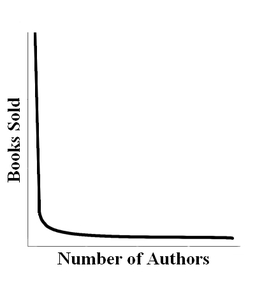
Amazon uses a secret algorithm to rank books based on sales (and presumably other parameters), and compares them to other books. We don't know how this algorithm works but there is enough evidence out there that points to one simple truth. The vast majority of books do not sell much. As a result of that, if you plot books sold against number of authors, what you get is what is called a "power curve" (see figure).

The sharp spike to the left represent the few authors that sell many books. In this small area you will find people like Amanda Hocking, John Locke, Barry Eisler and Joe Konrath. There is then a small transition zone that has authors that have decent but not spectacular sales. And then comes the very long tail that extends to the right. This is where you find the thousands of other writers that have almost no sales on their books. When you are in this tail it is common to find that even the sale of one copy can improve your book's Amazon ranking by hundreds of thousands of points.

Despite realizing this I was tempted to tweet something like "My book reached the top 4% of the Amazon Kindle store!" However, this, although not a false claim, would have been dishonest because it would not tell the whole story. I, and many others, are in that long tail to the right struggling to sell our books and make our way to the left. How will we make it? I don't know yet, but that is the challenge!


4 Comments

Beware of Amazon's Pricing Bot!

11/11/2011

0 Comments

 
Author James Crawford had an e-book on Amazon called "Blood Soaked and Contagious", but he decided that, as a promotion, he would publish the first 3 chapters of his book on Barnes and Noble for free. So when his promotional book was published the similarity between the free B&N version and the Amazon version confused Amazon's pricing mechanism, which proceeded to list his book on Amazon as "free". By the time the problem was corrected 5,000 plus copies of his book had been given away for free and, due to Amazon's pricing policies, he is not entitled to any compensation for this error. You can read the author's account here.

Pricing a book for free on other outlets is a very common trick writers use to give their books away for free on Amazon because of Amazon's price matching policy. What writers need to remember is that the process is automated; it is a robot, a program, which makes the decisions. So if you have a book on Amazon make sure any promotional excerpts you publish elsewhere at a lower price are very obviously different from your Amazon book. Lest you confuse Amazon's pricing bot!

Please check out my first collection of short stories, The Sun Zebra. 

0 Comments

Amazon to make Kindle Books Available for Lending by Libraries

9/29/2011

0 Comments

 
Amazon will make e-books available for lending by libraries in the United States, which means that Kindle users will be able to borrow e-books from libraries. Currently owners of Sony Readers, Nooks, iPads, and smartphones are able to borrow e-books from libraries. In fact from 2009 to 2010 e-book loans increased 200% (15 million digital checkouts of 400,000 e-books). Since the Kindle is the most popular e-book platform, this move is expected to increase demand and it will be one more way to give authors visibility.

This is good news for writers that are seeking to expand their readership. I have mentioned before that many authors seek to give away some of their e-books and they employ several strategies like posting them for free on B&N via Smashwords so that Amazon will match the price, or even posting their work on book pirating websites.

Therefore making available Kindle e-books for lending by libraries is a plus. However there is one caveat. Libraries are likely to favor the e-books of authors with some name recognition. So you see, there is no free lunch here. The road to the top is still steep and slippery but as we get closer initiatives like these will make it easier.

0 Comments

Giving Kindle Books Away for Free at Amazon

7/19/2011

0 Comments

 
Just thought I would share with you this tip that I read in cyberland.

Many Kindle authors want to give away some of their material for free on Amazon as a promotional strategy. The problem is that Amazon does not allow books to be given away for free. Digital books between 3 and 10 megabytes must be priced at a minimum of $0.99. And in case you are wondering, yes, selling your book at $0.99 is vastly different from giving it away for free. But there is a trick you can use.

Amazon also has the policy of price matching. That is, if a competitor like Barnes and Noble offers your book for a lower price then Amazon will match that price, at least for a while. So what many authors do when they want to give away their Kindle books is that they publish them for free on sites like Smashwords. Smashwords then distributes to Barnes and Noble and other book outlets. Amazon notices that their competitors have listed your book for free and lowers the price to zero for about a week or so at a time.

This has dramatic effects. Some authors report that their free books were downloaded at a rate of hundreds of downloads per hour with some reaching into the tens of thousands during the "free" period. Of course, these authors were not making money, but this is a very effective way to advertise yourself drawing attention to your other books and to your website.


0 Comments

Go for the Spike!

6/22/2011

5 Comments

 
As many of you know I intend to self-publish my Nell stories. To this end I have been reading and listening to what others have to say about the most effective strategies to be successful in this process. But recently I have been given a piece of advice that really surprised me.

I was planning to publish my book on as many platforms as possible, Smashwords, Amazon, B&N etc. As a novice author this would have consumed a significant amount of my time learning the intricacies of formatting and publishing for each medium. But the advice I was given is the following: publish on one of the big players in the market (e.g. Amazon) and devote your efforts to promotion there, don't waste your time on the smaller outfits (e.g. Smashwords).

Why would this make sense? Wouldn't it make more sense to publish in as many places as possible to get all the sales you can? The answer is "no" and the reason is the following:

Consider the following scenario. I offer to buy 1000 copies of your book. I can do it in two ways. In option "A" I will buy 100 copies per month over 10 months or, in option "B" I will buy all the 1000 copies in one month. Which one would you choose?

The obvious choice is "B" for the simple reason that sales increase when your book acquires more visibility, and your book acquires more visibility when it sells. In other words, if you sell 1000 copies in one month the odds are that more sales will follow because your book will climb quickly in ranking and get noticed, whereas a steady but low rate of sales may keep it under the radar screen.

So the idea is to go for the spike. Make your book climb in ranking quickly and then devote all your time to do the promotion necessary to keep it there or make it go higher. This also means that making a concerted effort to combine several promotion strategies at once (say immediately after the launch of your book) would be more valuable than publishing your book and then developing its promotion piecemeal one strategy at a time.

This is of course just some advice I got, but it makes sense to me. What do you think?


5 Comments
Forward>>
    Picture

    I am a tinker, tailor,
    soldier, sailor,
    rich man, poor man,
    beggar-man, thief!

    Follow Phantomimic on Twitter

    RSS Feed

    Blogroll

    Laura Novak
    Barbara Alfaro
    Suzanne Rosenwasser
    Sunny Lockwood
    Christine Macdonald
    Jennie Rosenbaum
    Kristen Lamb
    Joe Konrath
    Sweepy Jean
    Ingrid Ricks
    The Jotter
    Robert David MacNeil
    Molly Greene
    The Passive Voice
    Third Sunday Blog Carnival
    Marilou George
    Laura Zera
    Jeri Walker-Bickett
    Lia London

    Categories

    All
    Advice For Writers
    Amazon
    Art
    Author
    Ballet
    Bloggers
    Bluegrass Music
    Book Promotion
    Book Review
    Cats
    Censorship
    Clopper Mill
    Coffe
    Cool Places
    Coral Castle
    E Books
    E-Books
    Enchanted Highway
    Fair
    Fiction
    Glenstone
    Goodreads
    Grammar
    Guest Post
    Harry Potter
    Indie
    Interview
    Issues
    Kdp Select
    Kindle
    Milestone
    Milestones
    Muses
    Nell
    Novel
    Nuclear Missile Sites
    Painting
    Picture
    Poe Toaster
    Poetry
    Politics
    Prague Quadrennial
    Print Books
    Quality
    Reading
    Restaurant At Patowack Farm
    Science
    Scribd
    Self Publishing
    Self-Publishing
    Short Story
    Song
    Spirit Women
    Spotlight
    Sun Zebra
    Supernatural
    Theater
    The Sedlec Ossuary
    Video
    Women
    Words
    Writer
    Writers
    Writer's Block
    Writing

    Archives

    April 2020
    November 2019
    September 2019
    August 2019
    July 2019
    May 2019
    April 2019
    January 2015
    June 2014
    May 2014
    April 2014
    October 2013
    June 2013
    May 2013
    February 2013
    January 2013
    December 2012
    November 2012
    October 2012
    September 2012
    August 2012
    July 2012
    June 2012
    May 2012
    April 2012
    March 2012
    February 2012
    January 2012
    December 2011
    November 2011
    October 2011
    September 2011
    August 2011
    July 2011
    June 2011
    May 2011
    April 2011

    Picture
    Picture
    Picture

    RSS Feed

Powered by Create your own unique website with customizable templates.