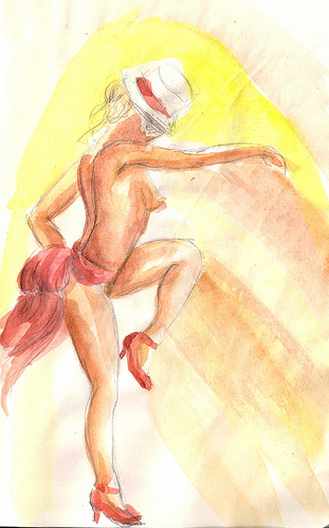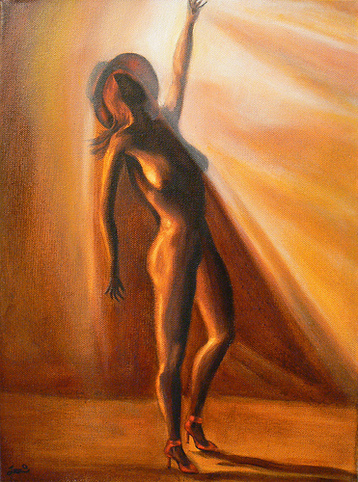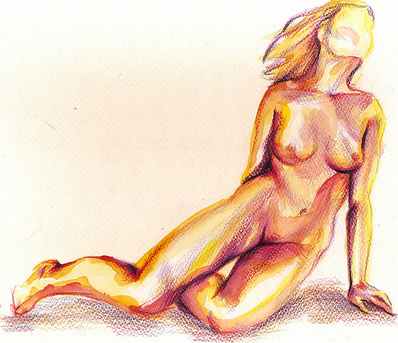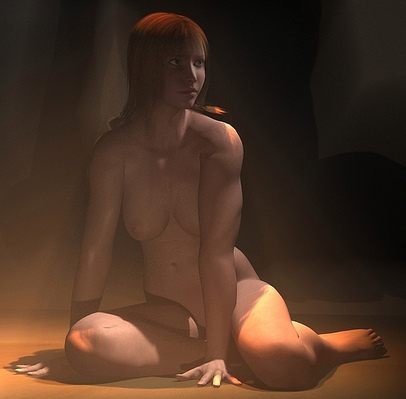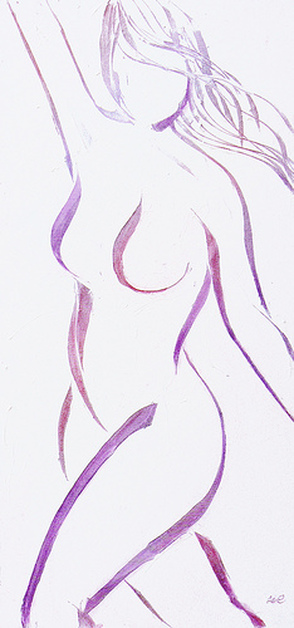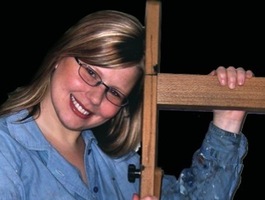
Today I am posting an interview with professional artist Jennie Rosenbaum. Jennie is an American painter living in Australia who specializes in nudes, but the twist is she doesn't use live models, she uses 3D computer graphics. Jennie's paintings have received awards in many local and international exhibitions and are coveted by collectors world-wide. I was attracted at first to Jennie's art because of her impressive mastery in the portrayal of the female form and her use of light. It was her artwork that inspired me to write my first poem She's Bathed in Light.Jennie is also remarkable in that she was involved in a car accident back in 2004 that left her with a chronic pain disability. However, through sheer will and with help from family and friends she has been able to paint her way through it, and last year she achieved her dream of becoming a mother. In addition Jennie is also an outspoken activist in favor of what she calls nude rights, the fight against censorship, and she leads an online group for people with disabilities. So her story is not only one of artistic success but one of conscience, courage and perseverance.
Now let's get to know Jennie's art and the woman behind the paintings! Rolando: You have used several techniques to portray the female form. I like your use of color in your watercolor nudes, the simplicity of your impasto nudes and your use of light in your ochre nudes. Do you have a favorite way to represent the female body or do you think each technique captures a specific part of its essence? If so which one?
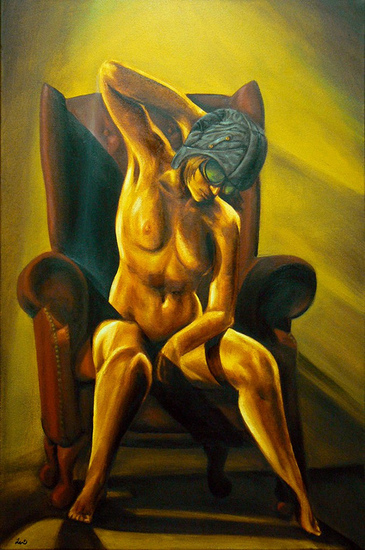
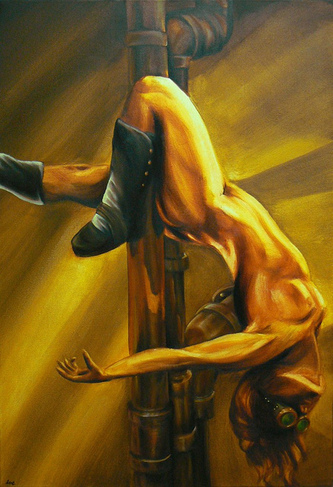
Jennie: I think each technique fills in a space. Each one occupies a different area of the brain for me and enables me to focus on specific elements of the figure. The ochre works, as you say, are about the way the light caresses the body. I like to explore chiaroscuro, extreme light and dark, to create a three dimensional aspect. As this technique involves removing paint, building layers and stripping them back again, I think it is sometimes the most raw and primal, the most emotional of the three.
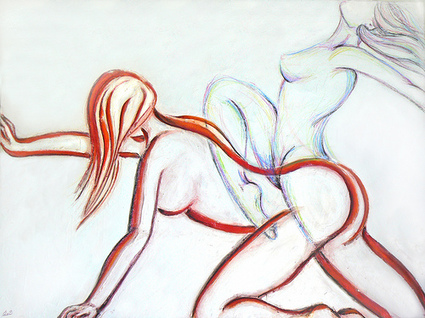
My impasto pieces are about the beauty of line and the purity of form. They are inspired by Asian calligraphy and are oddly obsessive. Each line tells a story, and each one must be precise. I like the incongruity between the obsessive, demanding effort, and the simplicity and elegance that is the finished result.
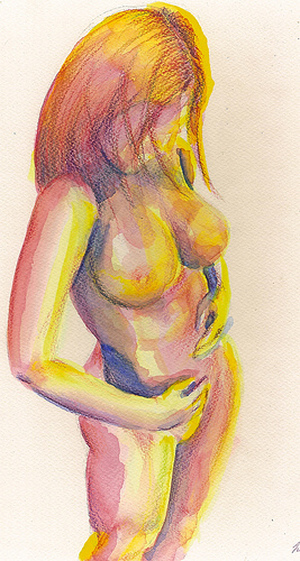
My watercolors are the softer, more relaxed side. I get too wound up and too tight, like a coiled spring, so watercolors are a perfect counterbalance. The flow of water and delight in mixing colors together give me a chance to unwind. I also like to use them to refresh my skills in life drawing, in seeing and noticing the interplay of color in a more subtle way.Go to Next Question Go to Last Question
Rolando: You have expressed your abhorrence for pornography and at the same time decried how contemporary society equates nudity with sexuality. You have stated that nude art does not have to be sexual but it that can be sensual. My question is: Where is the dividing line? At what point can nude sensual art degenerate into pornography and how do we know the difference?Jennie: It's easy to say, we know it when we see it, but that is not always the case anymore, with nude hysteria reaching a fever pitch. I think there are dividing lines. Ones that we can spot if we keep our eyes open. The intention of the artist is usually clear. Posing, exaggeration, lighting, mood, a glance, hand placement- little details give intentions away. I have problems with pornography because I believe it's one of the reasons we have problems discerning these dividing lines now. When nudity is primarily shown as shameful and sexual then that is all anyone can think of. Pornography helps reinforce that. It also reinforces a lot of negative body issues, stereotypes and gender disparity. Porn used to be a playful thing, an art form in its own right, but it has degenerated into a denigration of sex, gender and the beauty of nudity.
Go to Next Question Go to Previous Question
Rolando: The majority of your paintings are women, and you have stated that nude women are more aesthetically pleasing than nude men, that nude women are beautiful, while nude men are interesting but not beautiful. Do you think that this is a cultural convention or an absolute? For example in some societies like the ancient Greeks, male nudity in art was held in high regard.Jennie: I think it has become a cultural convention. Look at a men's magazine, what will you see? Women. Look at women's magazines, what do you see? More women! If anything they are usually more scantily clad. Fashion, movies, everything revolves around the female body. We are obsessed. I could say that is because much of the media is male dominated and that fosters a simultaneous celebration of the female body and a fear of the male nude. That isn't to say the pendulum won't swing back again. Greek men were portrayed as powerful specimens, but, in those days there were fewer concerns about nudity, less knee jerk fear of homosexuality. Nudity and homosexuality were embraced, bodies were gifts from the gods and to be celebrated. I think we can learn a lot from the ancient Greeks!
Go to Next Question Go to Previous Question Go to First Question
Rolando: Much in the same way that many writers get writer's block, is there such a thing as painter's block? Have you gone through long periods where you just stared at the empty canvas or that nothing that you began painting seemed to satisfy you?Jennie: Oh without a doubt! Every painter I know suffers from blocks from time to time, they seem to have similar symptoms and can go from a couple of hours of frustration to weeks or even months of doldrums, self-deprecation and doubt. Everyday I face fear and frustration with my paintings, from a stroke that didn't land quite right to suddenly realizing that some anatomy is wrong and that nothing short of redoing the entire piece will fix it! Personally I find the best way through it is to just keep going, do something different, try something new, do something silly - just keep creating. That's the key.
Go to Next Question Go to Previous Question Go to First Question
Rolando: OK, Jennie, let me put you on the hot seat for a moment. You decry how modern commercial society makes us feel uncomfortable with the imperfect shape of our bodies constantly reminding us how fat we are and so forth. However the majority of the women in your paintings have awesome bodies. Maybe a woman would look at your paintings and say, "I wish I looked like that." Do you think you are contributing to the negative stereotype by painting mostly women with beautiful shapes?Jennie: I try to explore other body types but no matter what shape my model is they almost always end up a similar shape. A gallery owner once told me that my works were fantastic! The figures are just like something out of playboy, that I don't paint like a woman at all! That gave me a massive block for a while, I had a hard time getting past what he had said as it was everything I wanted to avoid. My husband, Liam, answered this for me in the end. My pieces are almost always depicting my own figure. In different stages to be sure, but he told me I keep returning to my own body and exploring that, the shapes and proportions are always the same because they are familiar to me. As I have a hate/hate relationship with my figure you can imagine how that gave me pause. I have a condition known as body dysmorphic disorder, something that prevents me from seeing my own figure as it truly is. No matter what size I am I see the same thing. Fat! Even when I had a waist size as low as 17 inches. This revelation from Liam has really helped to me move past this issue and to start appreciating what I have, clearly some part of my brain knew and just had to educate my eyes! Lately, I have been exploring other body types and I look forward to branching out further, I see it as a sign of growth in my own personal development, perhaps I am becoming less obsessed! Go to Next Question Go to Previous Question Go to First Question
Rolando: Related to the last question, you have talked about the pros and cons of using virtual models. One of the cons is that virtual models don't have the imperfections that live models do. Do you think you are limiting yourself by painting mostly from virtual models?Jennie: The new technology available is just outstanding. I am launching on a new project soon to bring 3D life (unlife) drawing to everyone and there will be a range of body types, male, female, small, large, I'm really looking forward to it. While virtual models can't get the same...gravity as live models, I think we can explore a lot that way. I do keep my senses and my anatomy skills honed by working from life or from photographs of real people on a regular basis. By using what I know about anatomy I can fill in the blanks left to me by my virtual models. Go to Next Question Go to Previous Question Go to First Question
Rolando: Let me ask you a final but very personal and difficult question. It is often commented that the great challenges that we face in life are the ones that help us grow and make us better persons. You have stated that it took being hit by a car to discover your passion in life: that in order to deal with your disability you took up painting with a focus that allowed you to become the artist and individual you are today. So the question is: If you could return to the past, to the woman you were before the accident, with only a few minutes memory of what your future will be, would you use those minutes to make a change and prevent the accident from happening, knowing that then you would probably never become the painter and person you are now?Jennie: I think I was always destined to be an artist. It's what I always wanted to be. I was lured away by the siren song of money and regular paychecks. I loved management and being in control, the sound of my high heels on the marble floors, but the truth is that I wasn't happy. I was working my way into an early grave. I like to think that if it hadn't happened I would still have made the decision on my own. But I would have lost even more precious time. Because of this accident I am home with my baby instead of working in the city, I have my husband at home caring for us both, I have work that I love. I have passion and happiness. It's hard to completely resent it! I believe things happen for a reason and that the universe just wanted me to be an artist. I wish it hadn't taken being hit by a car, but I'm not sure I would have listened to anything more subtle. I really did like the money. I would however like the pain to go away now though! Thank you very much Jennie, you are a lovely person and I greatly admire your work.
You can see more of Jennie's work on Flickr, visit her website, read her blog, or follow her on Twitter or Facebook.
Please note that all pictures shown in this interview should not be copied, or reproduced in any other work of art without Jennie's permission.
Go to Previous Question Go to First Question
|