In this digital age spell checkers have made typos come to the forefront as the bane of writers. Typos arise when we miss a letter (our massage treatments help relive your pain), replace a letter with another (we feature some-day shipping), switch the order of letters (I know judo, karate, jujitsu and other forms of marital arts), or even when we miss a space (the penis mightier than the sword).

Many typos are particular to each author. I, for example, tend to write "bellow" instead of "below", "were" instead of "where", and "of" instead of "off". In my book The Sun Zebra, I caught a typo that I had overlooked despite a few rounds of editing. I wrote "stripped quadrupeds" instead of "striped quadrupeds". Although finding typos may bother some people, I don't mind a few. In fact, I think they are fun to discover.

In some books I have read recently I have found some fun typos like "god judgment" instead of "good judgment", "roll model" instead of "role model", and "fir" instead of "fur". But the most unfortunate and hilarious of typos is probably what happened to the hero in a book by Susan Andersen.

Leave a comment and share some typos, they can either be your own or someone else's.

                                  ***
If you like this blog you can have links to each week's posts delivered to your e-mail address. Please click here.
 
 
Amazon will make e-books available for lending by libraries in the United States, which means that Kindle users will be able to borrow e-books from libraries. Currently owners of Sony Readers, Nooks, iPads, and smartphones are able to borrow e-books from libraries. In fact from 2009 to 2010 e-book loans increased 200% (15 million digital checkouts of 400,000 e-books). Since the Kindle is the most popular e-book platform, this move is expected to increase demand and it will be one more way to give authors visibility.

This is good news for writers that are seeking to expand their readership. I have mentioned before that many authors seek to give away some of their e-books and they employ several strategies like posting them for free on B&N via Smashwords so that Amazon will match the price, or even posting their work on book pirating websites.

Therefore making available Kindle e-books for lending by libraries is a plus. However there is one caveat. Libraries are likely to favor the e-books of authors with some name recognition. So you see, there is no free lunch here. The road to the top is still steep and slippery but as we get closer initiatives like these will make it easier.


Jeb Corliss, wingsuit flyer extraordinaire, and also one bat-crap crazy dude, has succeeded in flying through the arch of the Tianmen Mountain in China, also known as heaven's gate.
This feat dwarfs his previous achievement of "grinding the crack" in the Swiss Alps!


A while back I read another article decrying the poor quality of self-published books. Apparently someone who had never bought self-published books before decided to "take a look" and bought a few. The author of the article said she was "horrified" to find poor writing and formatting, typos, and even spelling mistakes. She then went on a rant about how self-published books are lowering the standards and how she will never buy self-published books again.

This happened some time ago and I did not react immediately. I can't remember who the author was and I don't know whether the article is still up on the net. But this article lingered in my mind and only recently did it resurface to annoy me. Today I will respond to it. I have only one thing to say.

It's a market! OK? It's a #%&* market!

I mean, really, when you go to your local market do you brainlessly place items in your shopping cart and buy them without taking a look at them? Then why do you think Amazon or B&N are any different? All markets have products of different quality. If you did not examine the book before buying it, if you just bought it, for example, because it had a nice cover or because it cost only $0.99, then whose fault is it if you find you didn't like it?

To avoid these problems please do these things before buying a book.

1) Check the sample pages. Do not buy the book if the sample pages look lousy.

2) Check the reviews of the book. Do not buy a book with no reviews or a bad overall review.

3) Visit the author's web-site and sample their work. If you don't like the author's writing the odds are you won't like that particular book.

In the self-published world there are no gatekeepers. No editor is going to do the thinking for you. You are the buyer and it is up to you to decide whether the book you are about to buy is good enough for you. Please follow these simple rules and spare us from yet another article about the poor quality of self-published books.

Thank you.


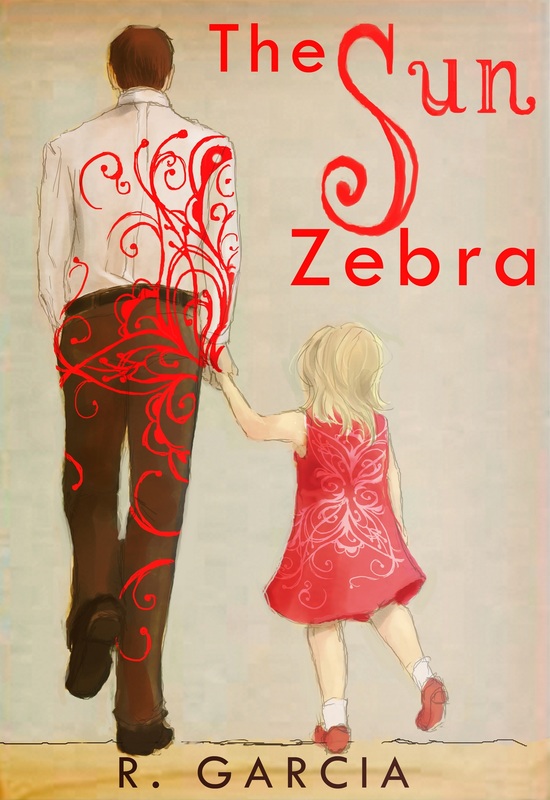
Please check out my first collection of short stories, The Sun Zebra


Apparently stroking sharks around their snouts puts them into a state that is called "tonic immobility". Why this happens it is not known for certain but it may have to do with over-stimulation of receptors in that area. The "charming" takes place around minute 2, but the whole video is worth watching just for the visuals and the great Spanish music!


Picture
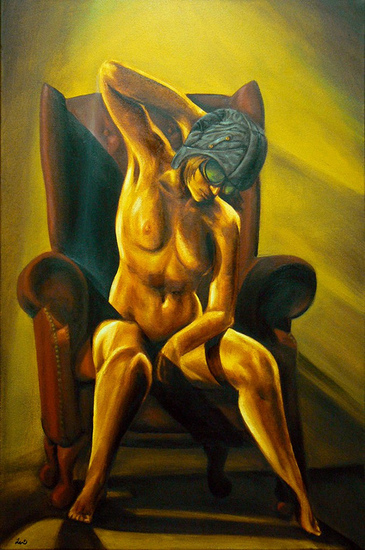
Today I am posting an interview with professional artist Jennie Rosenbaum. Jennie is an American painter living in Australia who specializes in nudes, but the twist is she doesn't use live models, she uses 3D computer graphics. Jennie's paintings have received awards in many local and international exhibitions and are coveted by collectors world-wide. I was attracted at first to Jennie's art because of her impressive mastery in the portrayal of the female form and her use of light. It was her artwork that inspired me to write my first poem She's Bathed in Light.

Jennie is also remarkable in that she was involved in a car accident back in 2004 that left her with a chronic pain disability. However, through sheer will and with help from family and friends she has been able to paint her way through it, and last year she achieved her dream of becoming a mother. In addition Jennie is also an outspoken activist in favor of what she calls nude rights, the fight against censorship, and she leads an online group for people with disabilities. So her story is not only one of artistic success but one of conscience, courage and perseverance.

Now let's get to know Jennie's art and the woman behind the paintings!

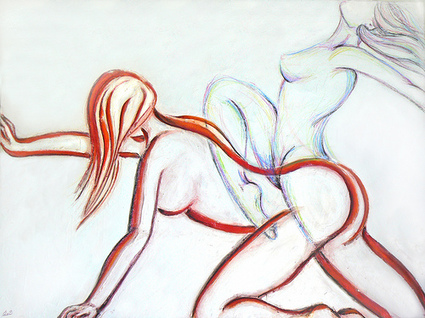
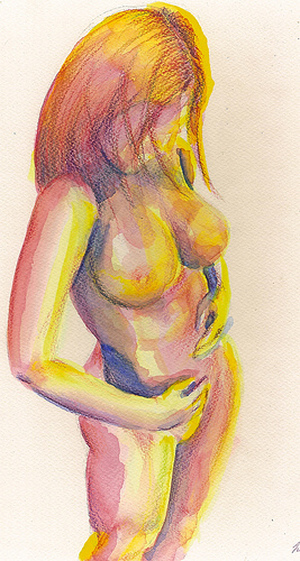
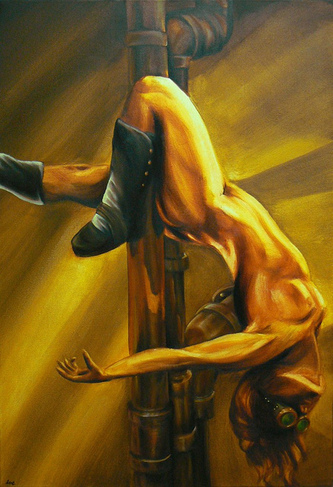
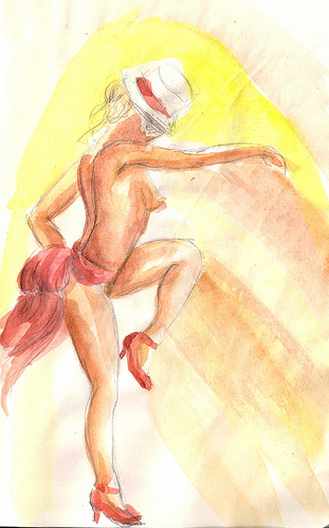
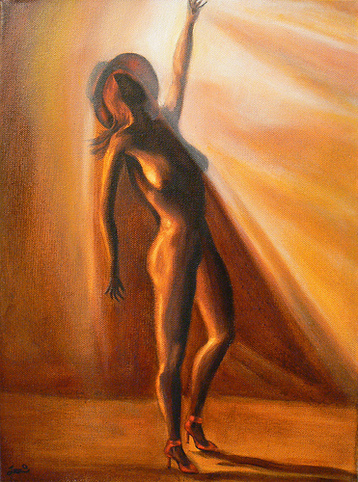
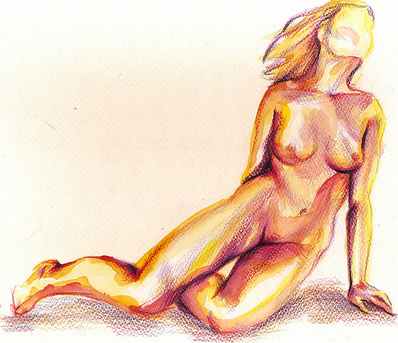
Rolando: You have used several techniques to portray the female form. I like your use of color in your watercolor nudes, the simplicity of your impasto nudes and your use of light in your ochre nudes. Do you have a favorite way to represent the female body or do you think each technique captures a specific part of its essence? If so which one?

Picture


Jennie: I think each technique fills in a space. Each one occupies a different area of the brain for me and enables me to focus on specific elements of the figure. The ochre works, as you say, are about the way the light caresses the body. I like to explore chiaroscuro, extreme light and dark, to create a three dimensional aspect. As this technique involves removing paint, building layers and stripping them back again, I think it is sometimes the most raw and primal, the most emotional of the three. 


Picture


My impasto pieces are about the beauty of line and the purity of form. They are inspired by Asian calligraphy and are oddly obsessive. Each line tells a story, and each one must be precise. I like the incongruity between the obsessive, demanding effort, and the simplicity and elegance that is the finished result.

Picture


My watercolors are the softer, more relaxed side. I get too wound up and too tight, like a coiled spring, so watercolors are a perfect counterbalance. The flow of water and delight in mixing colors together give me a chance to unwind. I also like to use them to refresh my skills in life drawing, in seeing and noticing the interplay of color in a more subtle way.


Go to Next Question     Go to Last Question


Picture
Rolando: You have expressed your abhorrence for pornography and at the same time decried how contemporary society equates nudity with sexuality. You have stated that nude art does not have to be sexual but it that can be sensual. My question is: Where is the dividing line? At what point can nude sensual art degenerate into pornography and how do we know the difference?

Jennie: It's easy to say, we know it when we see it, but that is not always the case anymore, with nude hysteria reaching a fever pitch. I think there are dividing lines. Ones that we can spot if we keep our eyes open. The intention of the artist is usually clear. Posing, exaggeration, lighting, mood, a glance, hand placement- little details give intentions away. I have problems with pornography because I believe it's one of the reasons we have problems discerning these dividing lines now. When nudity is primarily shown as shameful and sexual then that is all anyone can think of. Pornography helps reinforce that. It also reinforces a lot of negative body issues, stereotypes and gender disparity. Porn used to be a playful thing, an art form in its own right, but it has degenerated into a denigration of sex, gender and the beauty of nudity.

Go to Next Question     Go to Previous Question


Picture
Rolando: The majority of your paintings are women, and you have stated that nude women are more aesthetically pleasing than nude men, that nude women are beautiful, while nude men are interesting but not beautiful. Do you think that this is a cultural convention or an absolute? For example in some societies like the ancient Greeks, male nudity in art was held in high regard.

Jennie: I think it has become a cultural convention. Look at a men's magazine, what will you see? Women. Look at women's magazines, what do you see? More women! If anything they are usually more scantily clad. Fashion, movies, everything revolves around the female body. We are obsessed. I could say that is because much of the media is male dominated and that fosters a simultaneous celebration of the female body and a fear of the male nude. That isn't to say the pendulum won't swing back again. Greek men were portrayed as powerful specimens, but, in those days there were fewer concerns about nudity, less knee jerk fear of homosexuality. Nudity and homosexuality were embraced, bodies were gifts from the gods and to be celebrated. I think we can learn a lot from the ancient Greeks!

Go to Next Question     Go to Previous Question     Go to First Question


Picture
Rolando: Much in the same way that many writers get writer's block, is there such a thing as painter's block? Have you gone through long periods where you just stared at the empty canvas or that nothing that you began painting seemed to satisfy you?

Jennie: Oh without a doubt!  Every painter I know suffers from blocks from time to time, they seem to have similar symptoms and can go from a couple of hours of frustration to weeks or even months of doldrums, self-deprecation and doubt. Everyday I face fear and frustration with my paintings, from a stroke that didn't land quite right to suddenly realizing that some anatomy is wrong and that nothing short of redoing the entire piece will fix it! Personally I find the best way through it is to just keep going, do something different, try something new, do something silly - just keep creating. That's the key.


Go to Next Question     Go to Previous Question     Go to First Question


Picture
Rolando: OK, Jennie, let me put you on the hot seat for a moment. You decry how modern commercial society makes us feel uncomfortable with the imperfect shape of our bodies constantly reminding us how fat we are and so forth. However the majority of the women in your paintings have awesome bodies. Maybe a woman would look at your paintings and say, "I wish I looked like that." Do you think you are contributing to the negative stereotype by painting mostly women with beautiful shapes?

Jennie: I try to explore other body types but no matter what shape my model is they almost always end up a similar shape. A gallery owner once told me that my works were fantastic! The figures are just like something out of playboy, that I don't paint like a woman at all! That gave me a massive block for a while, I had a hard time getting past what he had said as it was everything I wanted to avoid. My husband, Liam, answered this for me in the end. My pieces are almost always depicting my own figure. In different stages to be sure, but he told me I keep returning to my own body and exploring that, the shapes and proportions are always the same because they are familiar to me. As I have a hate/hate relationship with my figure you can imagine how that gave me pause. I have a condition known as body dysmorphic disorder, something that prevents me from seeing my own figure as it truly is. No matter what size I am I see the same thing. Fat! Even when I had a waist size as low as 17 inches. This revelation from Liam has really helped to me move past this issue and to start appreciating what I have, clearly some part of my brain knew and just had to educate my eyes! Lately, I have been exploring other body types and I look forward to branching out further, I see it as a sign of growth in my own personal development, perhaps I am becoming less obsessed!

Go to Next Question     Go to Previous Question     Go to First Question